
Impact of Middle East conflict on Emerging Europe
The Middle East conflict has led to a noticeable but uneven effect on Emerging Europe, largely through higher energy prices and softer confidence.
While the region entered 2026 from a position of relative strength, the sudden reversal in inflation and monetary policy expectations has paused the easing cycle and introduced downside risks to growth, consumption, and investment. The impact varies significantly across countries: Poland and Greece face manageable, though uncomfortable adjustments supported by diversification efforts and institutional buffers, whereas Turkey confronts a far more complex and fragile macroeconomic environment, where external imbalances, inflation, and currency pressures reinforce one another. Ultimately, the duration of the conflict will be decisive — while markets still assume a relatively quick normalization, a prolonged shock would likely force broader revisions in growth expectations and expose structural vulnerabilities more sharply across the region.
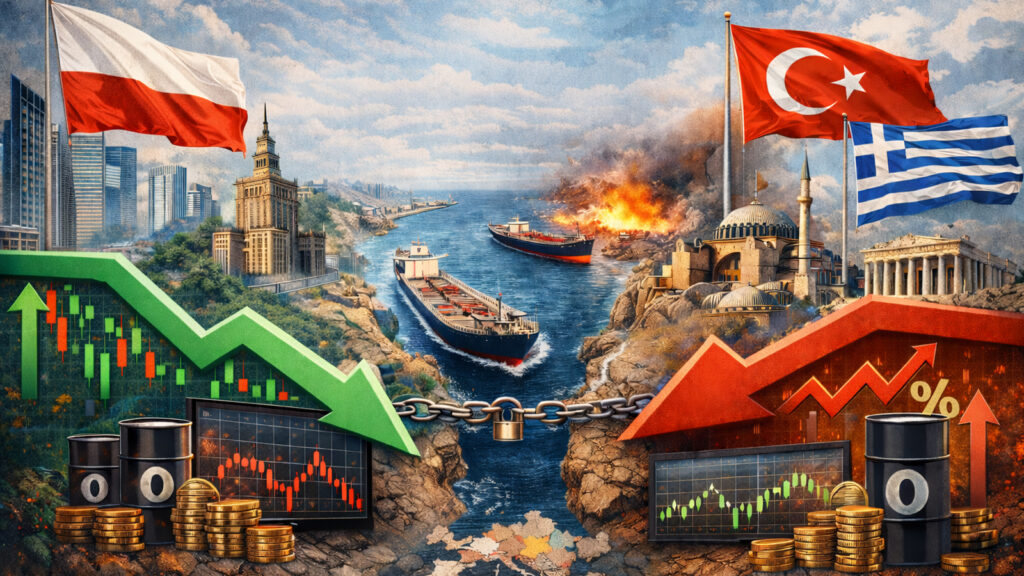
Energy shock to Emerging Europe.
The US-Israeli strikes on Iran on February 28 and the near-total closure of the Strait of Hormuz have delivered the most severe energy price shock to Emerging Europe since Russia’s 2022 invasion of Ukraine. Brent crude surged from $65/bbl to a peak of $120/bbl, settling at above $100/bbl by month-end. European natural gas (TTF) nearly doubled to €55/MWh — a sharp move, though still far below the €200/MWh+ extremes of 2022, reflecting a structurally better-supplied gas market. The disruption extends beyond primary fossil fuels. Qatar has reported a 17% LNG production cut expected to persist for 3-5 years (affecting ca. 20% of global LNG supply), while refined products, petrochemicals, fertilizers, and semiconductor inputs are all affected by the Strait’s closure.
Emerging Europe entered 2026 in good shape.
Regional growth was expected close to 3%, inflation had been moderating across most countries, and rate-cutting cycles were underway. The conflict has upended this trajectory, and average regional inflation estimates excl. Turkey have been revised up to 3.5%. Central banks across the region have frozen their easing cycles for the time being, with risks now tilting towards tightening. At the moment the markets seem to be positioned for a relatively swift resolution and at least a partial reversal of fuel prices as corporate earnings consensus for 2026 has not yet materially adjusted, meaning a prolonged conflict would risk triggering a wave of revisions.
The surge in energy prices if sustained will weigh on both business and consumer confidence. Higher prices could also constrain consumption. Further solid growth requires a lower savings rate given the slower disposable income we forecast for 2026. The confidence shock caused by the new war poses a risk that households may keep savings high at the expense of consumption growth. The Iran war and spike in prices is also a threat to private investment, which has already proven weak in recent years and may remain so at its current juncture. The non-cyclical element is public investment, of which the defense component may even accelerate, given that the Iran war creates a risk to Ukraine in receiving US weapons.
In terms of energy dependency, the three largest economies – Poland, Greece, and Turkey – sit at very different points on the vulnerability spectrum.
Poland’s overall energy import dependency of 45% is well below the EU average, underpinned by coal still generating over half of electricity – an effective buffer against gas price spikes. Greece, at 70–80% import dependency, has paradoxically increased its exposure by raising natural gas’s share of power generation to a record 41.3% in 2025, meaning TTF price spikes transmit directly to wholesale electricity costs. Turkey sits at the extreme, importing almost all its gas and crude. That vulnerability has already materialized as following the Israeli strike on South Pars gas field, Iran halted gas flows to Turkey entirely, removing 7bcm of annual supply (ca. 13% of imports) and forcing replacement through more expensive spot LNG.
Countries’ diversification investments of 2022–2025 are now paying measurable dividends. Poland has achieved zero dependence on Russian energy, sourcing gas through US LNG and Norwegian pipeline via Baltic Pipe. Greece’s Alexandroupolis FSRU, reaching full operations in late 2025, gives combined LNG import capacity exceeding 12bcm against domestic demand of 6–7bcm. Turkey’s structural hedges – the Sakarya Black Sea gas field and Akkuyu nuclear plant – will deliver equivalent relief only over 3-5 years and provide limited insulation in the current crisis.
Inflation pass-through mechanics vary also from mild discomfort to existential challenge. The inflation impact varies by order of magnitude. Poland’s 2026 CPI expectations have been revised from closer to 2% to above 3%, uncomfortable but manageable. Greece is running at 3.1%, above the eurozone average, with the fiscal council warning of 4% or higher under sustained oil prices. Turkey operates on an entirely different scale. Inflation at 31.5% in February is already far above the central bank’s 21% upped target band for the year-end. Central bank research estimates that a 10% oil increase raises CPI by 1pp, rising to 1.5pp when gas and coal pass-through is included – and these effects are non-linear, exceeding mechanical estimates as the shock persists. Market participants now expect year-end CPI at 25-26%, some even closer to 30%.
Monetary policy outlook across the three countries reveals divergent constraints.
Poland’s NBP cut to 3.75% in early March but has shifted to wait-and-see mode. Pre-crisis expectations of 3.25-3.50% are off the table and Polish economy can easily absorb a pause without major strain. Greece, inside the eurozone, has no independent tools. The ECB’s 2.00% rate is arguably too loose for an economy running above-average inflation and a positive output gap, though Greece benefits from borrowing costs unavailable to a standalone sovereign with 145% debt-to-GDP. Turkey’s central bank faces the sharpest dilemma. After cutting 100 basis points in January to 37%, it held in March and pushed the effective funding rate to 40% through operational measures. The easing trajectory has shifted roughly 100 basis points higher across the curve (year-end 2026 at 30.25%, 2027 at 22.25%), compressing the timeline for normalization. There are also signs that the market has begun pricing a formal rate hike, though the case is debatable as the 40% effective rate already offers ample real return above current inflation.
In terms of fiscal space and the capacity to support the economy the outlook is counterintuitive. Greece, despite 145% debt-to-GDP, has the strongest operating position. A primary surplus of 4.4% of GDP and a headline budget in surplus allows the government to deploy a €300mil emergency fuel package and a broader €5.3bn EU Social Climate Fund program. Poland’s fiscal position is the most stretched operationally, with a deficit at 6.3-6.5% of GDP and limited room for additional subsidies. Regardless, the government implemented fuel price caps and a VAT cut from 23% to 8%, costing ca. PLN 1.6bn per month. Turkey’s government debt at just 27% of GDP is the lowest of the three, but any fiscal expansion risks feeding the inflation and current account deterioration. The government already subsidizes roughly 55% of electricity bills and 44-45% of gas costs. A critical buffer for the EU members is the availability of EU Recovery and Resilience Funds with 2026 being the last year for disbursements as well as the SAFE defence program, both insensitive to oil prices.
The energy shock’s most immediate macro transmission channel is the current account, where higher-cost fuel imports directly widen trade deficits. The scale of deterioration and the capacity to finance it differ dramatically across the three economies. Poland’s current account, at -1.5% of GDP, is manageable and the zloty has weakened only modestly (1.6% since the start of the conflict). Greece’s deficit at -5.7% of GDP will widen further but is institutionally protected by eurozone membership. Turkey’s external position is where the shock concentrates most dangerously. The current account deficit consensus has been revised to -$31.6bn for 2026 (from -$26.3bn pre-conflict), with 2027 at -$32.3 billion, implying longer lasting damage. Gross reserves have dropped $38.5bn from the beginning of the year to $155.8bn, while swap-adjusted net reserves are down $47bn to $20.5bn. The central bank has been conducting gold-for-FX swap operations in recent weeks to secure immediate foreign currency as approximately 75% of reserves is gold. On the flipside, one important positive signal is that the deposit dollarization has been entirely absent since the war began, suggesting domestic savers retain confidence in the lira framework.
Turkey does not merely face proportionally larger challenges but also qualitatively different ones, where energy costs, currency depreciation, inflation, and the current account form a self-reinforcing spiral. The economic administration faces an explicit trade-off – tightening across fiscal, income, and monetary policy would contain inflation and the current account but weigh on growth. Loosening would preserve growth but risk reigniting the lira-inflation spiral. The stabilization program’s credibility – painstakingly rebuilt over two years – is far easier to lose than it was to build but the recent steps taken by administration give confidence that the prudent policy stance shall be maintained. Poland and Greece, with their lower inflation starting points and stronger institutional anchors, simply do not face this dilemma in such existential terms.