
Turkey Stock Market Sell-Off: Why BIST 100 Fell 16% in September 2026
Why Turkey’s stock market fell 16% in September 2026
The Turkish index BIST 100 ended September down 16.5% in Turkish lira and 15.8% in euros. Two features of the drawdown matter more than its size. First, the selling was indiscriminate – large, liquid, foreign-owned companies with no connection to the investment funds’ Ponzi-like scheme fell alongside the names at the center of the scheme, because they were the only assets the distressed fund managers could easily sell. Second, the episode is domestic and institutional rather than macroeconomic. Nothing about Turkey’s disinflation path, external balance or corporate earnings changed in September – the oil price is a headwind, but it was one before the crisis.
Turkey’s mutual fund boom: how €16bn became €200bn in six years
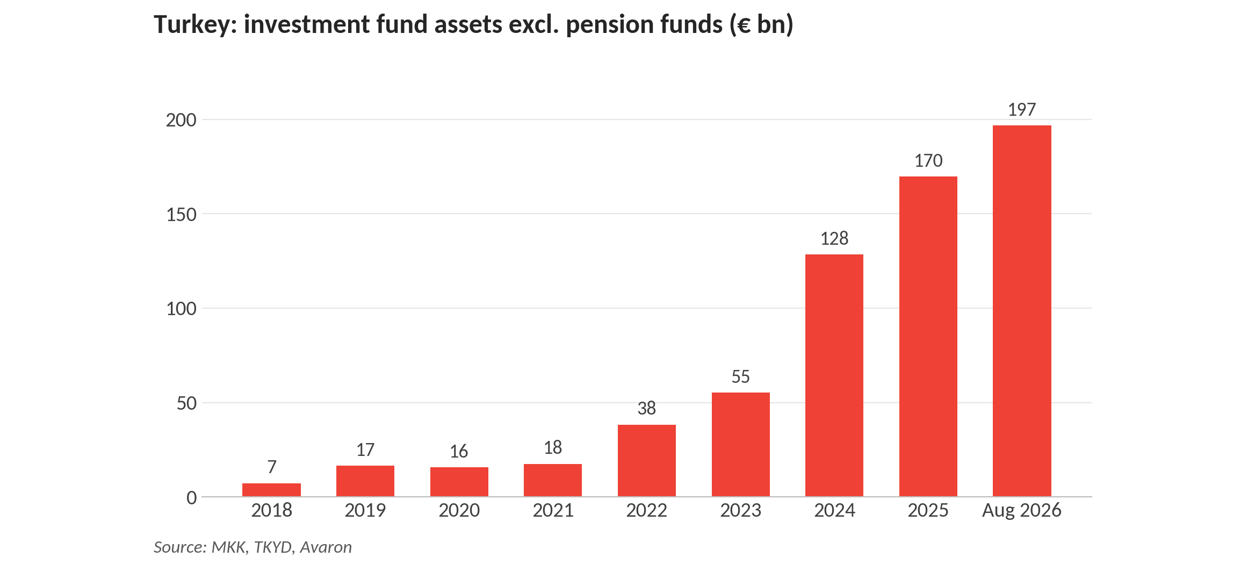
The fund industry at the center of September’s events barely existed six years ago. At the end of 2020, Turkish mutual funds held around TRY 142bn – some €16bn at the time – for roughly three million investors. By August 2026 the figure was TRY 11.1 trillion (around €200bn) across almost six million investors, a more than twelve-fold increase in euro terms, and the number of funds had risen from around 800 at the start of 2022 to more than 2,000.
Three things drove it. The retail investment boom that began during the pandemic lockdowns brought millions of new savers into the market through bank and brokerage apps, with Turkey’s centralized fund-distribution platform TEFAS giving every one of them full access to all investment funds. Deeply negative real interest rates in 2021-23 pushed household savings out of lira deposits and into anything that promised to keep pace with inflation. And once rates were raised sharply from mid-2023, money-market funds – which pay the policy rate and enjoy a lighter tax treatment than deposits – became the default home for cash, growing more than fivefold in 2024 alone. A system that had multiplied twelve times over in six years, distributing products from mid-sized managers to retail savers through the same channel as the largest banks, had grown far faster than the supervision around it.
How Turkish funds inflated low-float stocks into a liquidity trap
The September sell-off in Istanbul was the unwinding of a structure that had built up in Turkey’s domestic fund industry over the past year. A group of mid-sized portfolio managers had accumulated large, concentrated positions in thinly traded, low-free-float shares. Their buying lifted the quoted prices of those shares, which lifted their investment funds’ published returns, which attracted new retail money through TEFAS. The new money was deployed into the same or connected stocks. Some of these funds reported triple-digit returns in the first seven months of the year, and several of the underlying shares had risen many multiples since listing. The liquidity the funds promised investors was never consistent with what the underlying holdings could realize under stress.
Factoring company Destek Finans Faktoring illustrates the mechanism. Listed in February 2025 at a valuation of about TRY 16bn (roughly €420mil at the time), with Tera Yatırım as underwriter, the stock had risen more than 80-fold from its IPO price by its mid-July peak, when the company was worth around TRY 1.3 trillion (about €24bn) – more than refinery Tupras or the largest food discounter BIM, and close to a hundred times its book value for a company with a factoring portfolio of under TRY 20bn (€360mil). With a free float of only 25%, most of the shares available for trading sat in the funds that were marking them up. It has since its peak in July fallen 83% in liras and is being removed from the Turkish blue-chip BIST 30 and BIST 50 indices in the October index review.
Turkey’s regulator SPK acted too late to stop the scheme
The Turkish capital markets supervisory authority (SPK) has acknowledged that it identified abnormal, fundamentals-defying price formation in low-float shares in the final quarter of 2025 and discussed it at the Financial Stability Committee in December. The decisive rule changes nonetheless arrived only on 28 August 2026, tightening concentration limits, valuation, repo and collateral practices, and related-party financing. Once funds were required to reduce concentrated positions, the cycle ran in reverse. Forced selling pushed down the equity prices, fund values fell, redemptions accelerated, and with their core holdings unsaleable the managers sold whatever was liquid, which meant the market’s large caps. BIST 30, the Turkish large cap index, fell 9.2% in euros in September.
From missed redemptions to 131 fund
On 15 September, fund management company Pusula Portföy was the first to announce it could not meet redemptions on time, and a day later Tera Portföy formally defaulted on redemption payments in its equity and money-market funds. Investors pulled close to €1bn from Turkish funds in a single day. The BIST 100 fell 5.5% on 16 September, tripping circuit breakers, with banks and industrials down in equal measure. The Financial Stability Committee met before the open on 17 September and described the problem as temporary and manageable. The same day the SPK closed all TEFAS-traded funds of seven managers – Tera, Pusula, Hedef, Atlas, A1 Capital, Pardus and Bulls – to purchases and redemptions and ordered 131 of their funds into liquidation. Isbank was appointed liquidator for the Tera funds and Ziraat Bank for the other six groups, and the liquidation window was later extended from three to six months. According to the SPK, the affected funds have 455,758 unique investors and held more than TRY 890bn (about €16bn) of assets at last published values – values that will not be realized in full once concentrated positions are sold into thin markets. The SPK has since approved interim payments to affected investors of up to TRY 1mil (about €18,000) each, calculated on net invested amounts.
Turkish prosecutors allege a Ponzi-like scheme
The criminal investigation has moved swiftly. Executives of Pusula, Tera and Hedef were detained within days, and by 25 September the Justice Minister reported 76 suspects subject to judicial action and 45 in custody. Prosecutors allege a “Ponzi-like” structure, aggravated fraud and violation of the Capital Markets Law; they are also examining whether listed-company owners paid for price support and whether money-market funds were used to finance group companies. None of the allegations has yet been tested in court. On 26 September the investigation widened with asset-freeze requests on 106 parties – 46 companies, 18 funds and 42 individuals – a list that swept in several listed issuers and even state-owned insurers. After an SPK review the next day, measures on 45 companies and 19 funds were lifted while those on individuals remained.
Turkey’s central bank spends €3.7bn to keep the lira stable
The central bank’s response was to separate price stability from financial stability. The Monetary Policy Committee had held the policy rate at 37% on 10 September, a week before the crisis broke, noting weakening domestic demand but warning that it would tighten if the inflation outlook deteriorated – with Brent above $100/bbl and the Hormuz standoff unresolved, there was no room to ease. When the fund defaults hit, the bank used its liquidity tools instead.
On 17 September, the morning after Tera’s default, it was announced that weekly repo funding would be increased in line with liquidity conditions, raised banks’ borrowing limits, and scheduled five direct purchase auctions for government bonds. The repo auction that day was lifted to TRY 300bn (€5.3bn), against the token TRY 1bn auctions it had been running since restarting the facility in late August. The purpose was explicit, to make sure banks had the lira to settle with brokerages and fund managers, so that a fund crisis did not become a banking crisis. On the foreign exchange side, gross reserves fell by €3.7bn in the week to 18 September, to €152bn, with most of the move on the day after Tera’s default. That was no larger than the weekly drawdowns already seen in early September, when the bank was managing the lira against a higher oil bill, so the crisis did not visibly accelerate the loss of reserves. The lira ended the month 1% stronger against the euro, helped by the drop in EUR/USD.
Why the Turkish sell-off is an opportunity for long-only investors
The liquidation of the 131 funds will run into 2027 and will produce intermittent selling in the shares those funds hold. Looking beyond that, the structural question is MSCI, which warned in June that it could consult on reclassifying Turkey to frontier status unless regulators showed progress on coordinated trading by November. The SPK’s August rules limit funds’ holdings in low-free-float shares and in companies linked to their managers, and the September liquidations dismantle the vehicles behind the coordinated buying MSCI objected to. Together they should reduce the risk of a downgrade that would force emerging-market funds to sell their Turkish holdings. For long-only investors in liquid, well-governed Turkish companies, a market sold indiscriminately for reasons unconnected to those companies is an opportunity rather than a reason to retreat.
Turkish equities in Avaron’s funds: valuations after the sell-off
Early October Avaron Emerging Europe Fund has 14% of its assets in Turkey, and the sell-off has left those holdings at some of the most attractive valuations in our universe: 7.2x 2027 forecast earnings and 3.9x EV/EBITDA for a group of companies expected to grow earnings by 22% over 2026-27 and to earn a 19% return on equity in 2027. Avaron Emerging Europe Smaller Companies Fund has 10% in Turkey, where faster growth commands only a modestly higher price: 8.1x 2027 forecast earnings and 3.6x EV/EBITDA for 28% expected EPS growth and a 27% return on equity in 2027. In both cases these are established businesses with strong market positions – leading consumer brands, the country’s main airport operator, an exporter with a multi-year order book. The sell-off marked them down with everything else. We see that as an opportunity, not a reason to retreat.